
Small businesses audit their software subscriptions annually and their card processing fees quarterly. International calling, meanwhile, hides inside the phone bill as a number nobody questions, priced by a mechanism nobody remembers agreeing to. For a company that calls suppliers, freelancers or customers abroad even a few hours a month, that line item rewards twenty minutes of attention — because the pricing spread in this market is wider than almost anything else a business buys.
A 49x spread on the same product
A minute of voice is a commodity, yet in July 2026 the same calling service prices a minute to a Mexican number at $0.02 and a minute to a German landline at $0.98 — a 49x difference on one rate card (Telvio’s published rates). The driver is not distance or quality but the termination fee: the charge set by the carrier that owns the receiving line, country by country, under local regulation. The internet leg of the call costs fractions of a cent regardless of destination; the regulated last mile is the entire price.
Two consequences follow for anyone budgeting calls. First, a call budget is meaningless without a destination mix: a firm calling Mexico and the United States ($0.02 and $0.03 a minute on the same card) has costs 20 to 30 times lower than one calling the Netherlands ($0.88). Second, intuitions from a decade ago are now wrong in specific ways — in Germany a landline now costs more to reach than a mobile ($0.98 against $0.68), a reversal of the old rule that mobiles are the premium destination. Assumptions about which numbers are cheap deserve a yearly re-check against the current per-minute international calling rates, the same way exchange-rate assumptions do.
The rounding tax
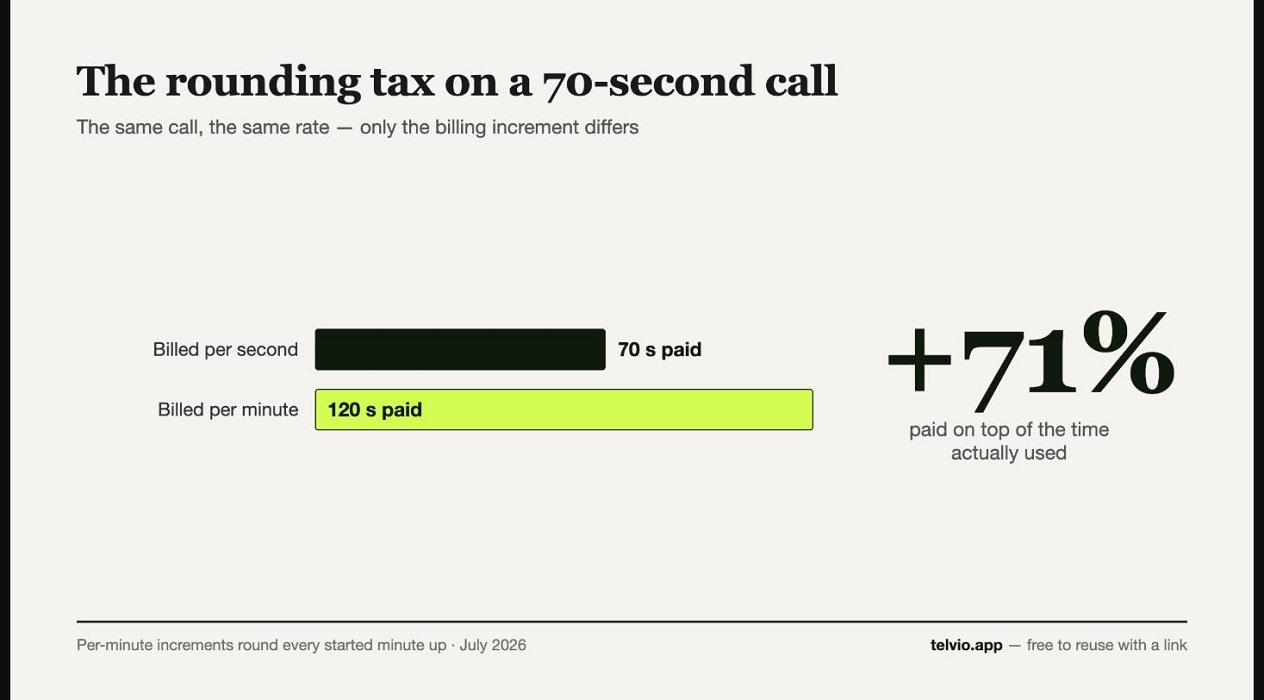
The per-minute price is the visible number; the billing increment is the hidden one. A rate billed in full-minute increments turns a 70-second call into two paid minutes — a 71% surcharge on the time actually used. Across a month of short confirmation calls, one-question calls and voicemail drops, minute-rounding quietly adds 30 to 70 percent to the effective rate, which routinely exceeds the difference between two providers’ headline prices. Per-second billing removes this entirely, and it is the first thing worth checking in any provider’s terms — before the rate itself.
Two smaller mechanisms deserve the same scrutiny. Connection fees — a flat charge per call placed — do to short calls what minute-rounding does, only worse. And credit expiry converts unused balance into breakage revenue: prepaid credit that lapses after 90 days is a discount that undoes itself for a business with seasonal calling patterns. The combination worth looking for is per-second billing, no connection fee, and credit that does not expire; as of July 2026, Telvio’s card meets all three, which makes it a usable benchmark to negotiate against even if you buy elsewhere.
Prepaid as a control mechanism
Beyond the arithmetic, the prepaid model has a governance property finance teams underrate: it caps exposure by construction. A compromised extension or a misdialed conference line on a postpaid carrier account becomes a dispute over an invoice that already exists; on a prepaid balance, the worst case is the balance. For a small business without a telecom administrator, replacing per-user carrier add-ons of $10 to $15 a month with a shared prepaid credit pool is frequently the largest single saving available — and it turns an open-ended liability into a budgeted one.
Bottom line
International calling is a commodity with a 49x price spread, a rounding mechanism that can add 71% to a short call, and expiry clauses that convert savings into breakage. Auditing it takes one afternoon: list your destination countries, check each against a current rate card, and confirm per-second billing, zero connection fees and non-expiring credit. Few line items return more per hour of attention.