
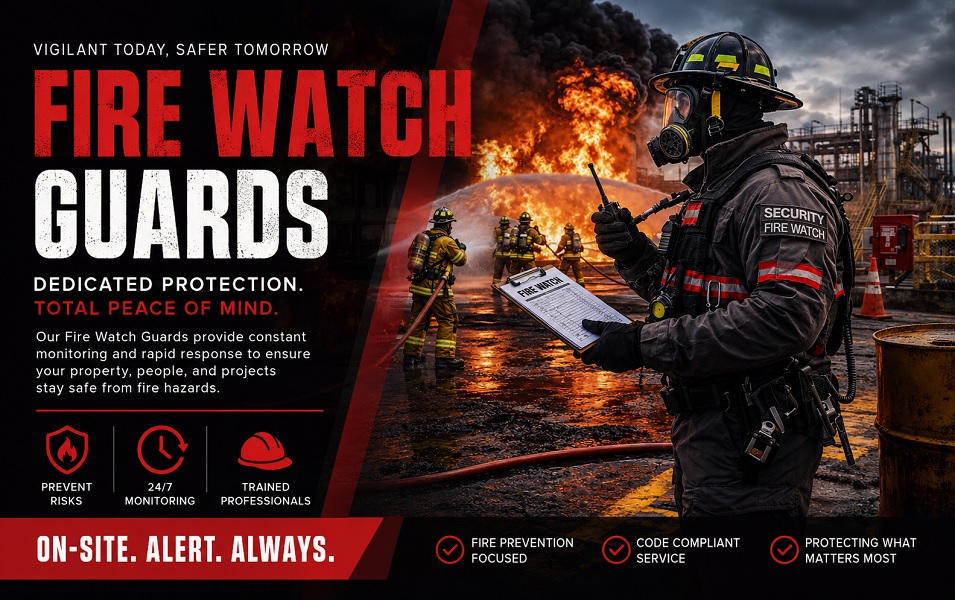
There’s a moment every business owner dreads — the one where a single oversight unravels years of hard work. Fire isn’t just a physical threat; it’s a financial catastrophe, a legal liability, and a reputational wound that rarely heals cleanly. That’s why smart operators across industries are quietly investing in a line of defense most competitors overlook. Fire Watch Guards are becoming one of the most strategic — and underutilized — assets a business can deploy, and the companies that understand this early are playing an entirely different game.
The Gap in Your Fire Safety Plan Nobody Talks About
Most businesses invest in smoke detectors, sprinkler systems, and fire extinguishers. They run annual drills, tick the compliance boxes, and move on. But here’s the uncomfortable truth — fire suppression systems fail. Sprinklers malfunction. Alarm panels go offline during maintenance. And in those windows of vulnerability, your building is essentially unguarded.
That’s the gap fire watch services were built to close.
When your fire suppression or alarm system is temporarily out of service — whether due to maintenance, malfunction, or new construction — local fire codes in most U.S. jurisdictions legally require you to establish a fire watch. This isn’t optional. It’s mandated by the National Fire Protection Association (NFPA) and enforced by local fire marshals. Ignoring it doesn’t just put lives at risk; it exposes your business to fines, forced shutdowns, and liability claims that can dwarf the cost of compliance.
What Fire Watch Guards Actually Do
Picture a trained professional walking your facility methodically — not just glancing around, but actively scanning for heat sources, smoke conditions, improper storage near electrical panels, blocked exits, and any early indicators of fire development. They’re documenting every round, every observation, every anomaly. And critically, they know exactly when and how to respond before a small problem becomes an irreversible one.
This is the daily reality of professional fire watch personnel. They operate as human early-warning systems — bridging the dangerous interval between a system failure and full restoration. In large commercial properties, warehouses, construction sites, hospitals, and event venues, their presence isn’t just a regulatory checkbox. It’s a genuinely life-saving layer of protection.
Experienced fire watch professionals also understand the specific risks of different environments. A construction site carries different hazards than a hotel undergoing sprinkler upgrades. A manufacturing floor has different combustion risks than a retail complex. Skilled guards adapt their surveillance protocols accordingly, which is something no automated sensor can replicate with the same contextual intelligence.
The Business Case Is Stronger Than Most Realize
Here’s where the conversation shifts from safety to strategy. Business leaders who frame fire watch purely as a compliance cost are leaving serious value on the table.
Consider the insurance angle alone. A properly documented fire watch program — with timestamped patrol logs and incident reports — can demonstrate due diligence to insurers in the event of a claim. In some cases, it actively influences premium negotiations. When an insurer sees that a business maintained continuous fire watch during a suppression system outage, that documentation signals responsibility and risk management sophistication.
Then there’s the operational continuity argument. A fire during a system outage, even a small one, can trigger mandatory inspections, temporary shutdowns, and code violation proceedings that halt your business for days or weeks. A single shift of fire watch coverage can cost a fraction of what one day of forced closure costs.
For industries where regulatory compliance is non-negotiable — healthcare, hospitality, food processing, data centers — the calculus is even more stark. A fire code violation in a hospital can result in Medicare and Medicaid funding reviews. In a hotel, it can trigger a licensing review. The financial exposure is asymmetric: the cost of protection is modest; the cost of a lapse can be existential.
Why Construction Sites Are Especially Vulnerable
Construction is where fire watch services see some of their most critical deployments — and for good reason. Active build sites are among the most fire-prone environments in commercial real estate. You’ve got hot work operations like welding and cutting running simultaneously near combustible materials. Temporary electrical installations create spark risks. Incomplete fire suppression systems mean the building’s permanent protection isn’t yet online.
NFPA 241 specifically governs fire safety during construction, alteration, and demolition — and it mandates fire watch during and after hot work operations when no suppression system is active. General contractors who ignore this aren’t just risking lives; they’re risking project delays, insurance cancellations, and personal liability that can follow them across future bids.
The smartest project managers treat fire watch as a built-in line item — not an afterthought. They schedule guard coverage the way they schedule inspections, because they understand that a fire on a half-built structure doesn’t just destroy the current project. It destroys the relationship with the client, the bond rating, and often the company’s reputation in a market where word travels fast.
The Human Element Machines Can’t Replace
There’s a temptation in modern business to automate everything that can be automated. AI-powered cameras, thermal sensors, and IoT-connected detectors are all valuable tools. But they share a fundamental limitation: they react. They alert after a condition has already developed to a detectable threshold.
A trained fire watch guard operates differently. They observe behavior — a worker smoking too close to stored materials, a piece of equipment running hotter than usual, a door propped open that compromises a fire compartment. They make judgment calls in real time, informed by training and experience, not just sensor thresholds.
There’s also the human accountability factor. When a guard signs a patrol log, they’re attesting to what they observed. That creates a chain of documented responsibility that protects the business legally, demonstrates good faith to regulators, and creates an audit trail that technology alone rarely provides in the same legally defensible format.
Choosing the Right Fire Watch Partner
Not all fire watch services are created equal, and the differences matter enormously. Guards should be trained specifically in fire watch protocols — not just general security. They should understand NFPA standards, local fire codes, and proper reporting procedures. Their patrol logs should be detailed, timestamped, and accessible to building managers and fire officials on demand.
Response capability is equally critical. A fire watch guard who identifies a developing condition needs to know exactly who to call, in what order, and how to initiate evacuation procedures without creating panic. That requires specific training, clear protocols, and coordination with local fire departments — not just a clipboard and a flashlight.
Businesses should also look for providers who understand their specific industry. A provider experienced in healthcare fire watch understands Joint Commission requirements. One experienced in industrial settings understands hot work permits and OSHA crossover. Specialization isn’t a luxury — it’s what separates compliant coverage from genuinely effective protection.
The Businesses That Get This Right Think Differently
There’s a certain operational philosophy shared by the companies that handle risk well. They don’t treat safety as a department — they treat it as a competitive advantage. When their fire suppression system goes down for scheduled maintenance, they don’t scramble. They already have a fire watch protocol in place, a trusted provider on call, and documentation systems ready to run.
This mindset extends beyond fire safety. It’s the same thinking that drives proactive cybersecurity investments, redundant supply chains, and business continuity planning. The best operators understand that resilience isn’t built in crisis — it’s built in the quiet moments when nothing seems urgent.
Fire Watch Guards represent exactly this kind of proactive intelligence. They’re not a reactive purchase. They’re a deliberate investment in operational continuity, regulatory confidence, and the kind of risk management discipline that separates serious businesses from vulnerable ones.
The Risk No Business Can Afford to Ignore
Every week, somewhere in America, a business faces a fire code citation, an insurance complication, or an incident that a properly deployed fire watch could have prevented or contained. The pattern is almost always the same — the system was down, the gap was left unguarded, and the assumption was that nothing would happen in that window.
Assumptions are expensive. The businesses that thrive long-term are the ones that refuse to make them — the ones that understand that protection isn’t about responding to what has happened. It’s about staying ahead of what could.
The shield was always available. The only question is whether your business is smart enough to pick it up.